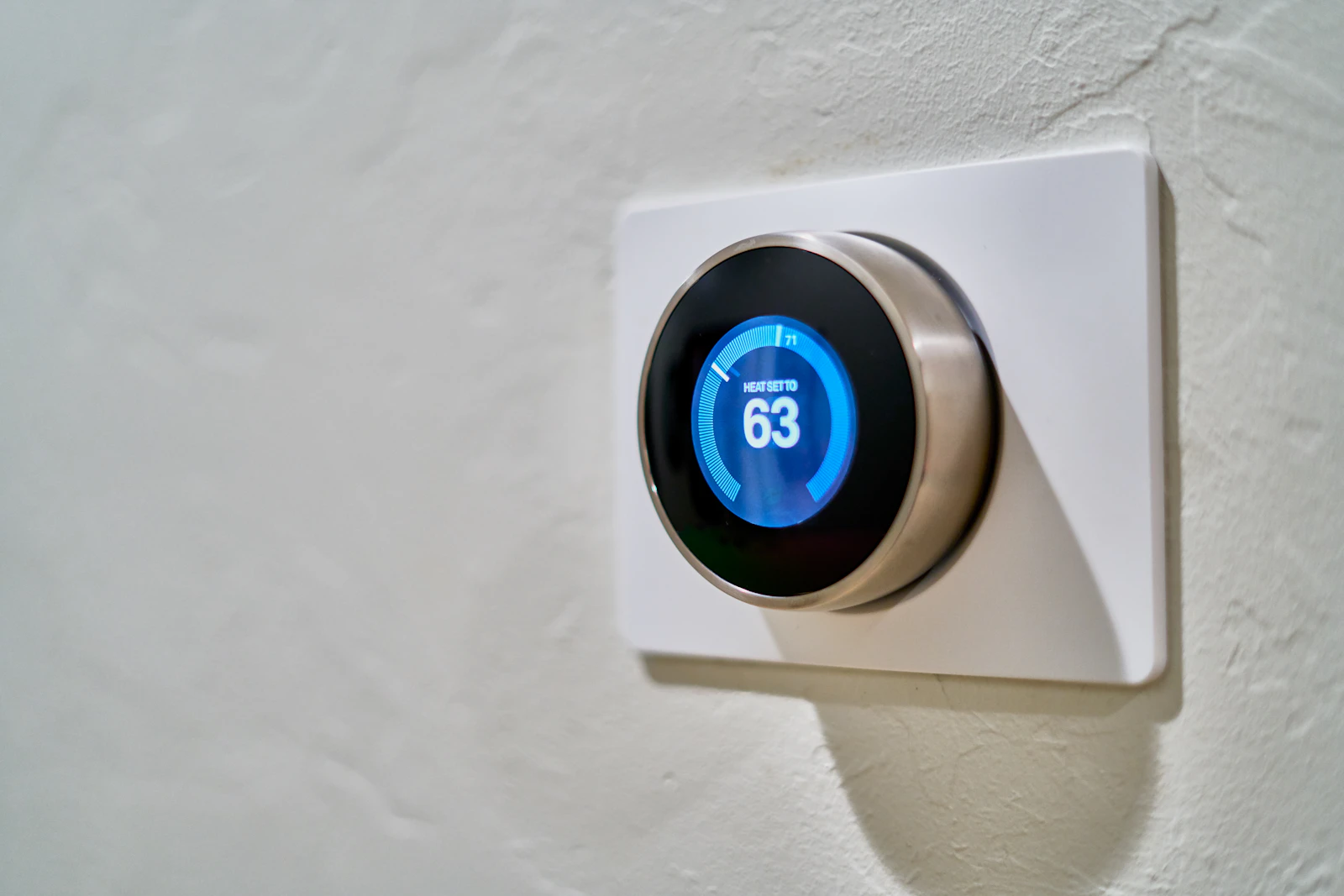
How much does AC cost in Texas?
There is no honest one-number answer. A Houston apartment, a shaded Dallas townhome, and a 2,500-square-foot older house can use very different amounts of electricity at the same thermostat setting. Equipment efficiency, humidity, insulation, ducts, shade, occupancy, and the weather all matter.
This calculator estimates the cooling portion of a hot-month bill and shows a 25% range in both directions. That range is intentional: it is more useful than pretending a simple online tool can predict an exact bill.
72°F vs. 78°F thermostat cost in Texas
Lower settings generally make an air conditioner run longer. The illustrative table below uses the calculator’s average-efficiency model for a 1,800-square-foot single-family home at 16.39¢/kWh. Your home can be materially different.
| Thermostat | Estimated cooling use | Estimated cooling cost |
|---|---|---|
| 72°F | about 1,070 kWh/month | about $176/month |
| 74°F | about 955 kWh/month | about $156/month |
| 76°F | about 850 kWh/month | about $139/month |
| 78°F | about 755 kWh/month | about $124/month |
What is the best thermostat setting for a Texas summer?
The best setting is the warmest temperature that is safe and comfortable for your household. Children, older adults, pets, medications, and health conditions can change what is appropriate. A gradual one- or two-degree adjustment is easier to evaluate than a large jump.
78°F is a common conservation reference point, not a rule for every person. During conservation requests, ERCOT’s current TXANS guidance says to raise the thermostat one or two degrees if safe.
Why Texas summer electricity bills spike
- Air conditioners run longer as outdoor temperature and humidity rise.
- Older equipment, leaky ducts, weak insulation, and direct afternoon sun increase the load.
- A plan’s advertised rate may not match the effective rate at your summer usage.
- Delivery charges, bill-credit thresholds, and time-of-use rules can change the final bill.
That is why the results estimate both cooling use and a total hot-month usage tier. Before enrolling, compare each plan’s complete estimate at that usage and review its Electricity Facts Label. See our Texas plan-traps guide and delivery-charge explainer.
How this Texas thermostat calculator works
The estimate starts with home size and a cooling-intensity assumption for the selected home type. It adjusts for home efficiency and uses a relative temperature-load model around 78°F. A simple non-cooling baseline is added only to estimate a likely plan-usage tier. Results are rounded and displayed as a broad range.
Sources and review date: reviewed August 15, 2026. The default 16.39¢/kWh rate is the EIA March 2026 Texas residential average; EIA explains that statewide averages are not an individual customer quote. Conservation context comes from ERCOT TXANS. General setback context comes from the U.S. Department of Energy. This calculator is informational, not an HVAC load calculation or bill guarantee.
Frequently asked questions
How much does it cost to run AC in Texas?
Cooling cost varies by home size, insulation, equipment efficiency, thermostat setting, weather, and electricity rate. This calculator provides a broad range using those household inputs rather than claiming one statewide cost.
How much can changing the thermostat by one degree save?
There is no universal dollar amount. This calculator models roughly a six percent cooling-energy change per degree around a 78°F reference, then shows a wide range because real homes and weather differ.
Is 78°F the best thermostat setting in Texas?
There is no single safe and comfortable setting for every household. 78°F is a common conservation reference point. ERCOT currently advises raising the thermostat one or two degrees when conservation is requested, if safe.
Does this estimate include my whole electricity bill?
The cooling-cost range covers estimated air-conditioning energy. The hot-month usage range adds a simple non-cooling household baseline, but it cannot predict every appliance, fee, credit, tax, or weather condition.